Universidad de Antioquia · Diplomado en Odontología Estética · Esp. Auditoría en Salud (CES)
Más de 17 años de experiencia en odontología clínica y estética
TP 70196663 · Registro profesional 5-4513-08
Choosing dental implants in Colombia involves much more than booking a flight and scheduling a procedure. At Dharma Dental, we begin the process before you travel, reviewing your case, requesting the necessary diagnostic records, and helping you understand each stage of treatment. Our goal is to give you a clear clinical and logistical roadmap, so you arrive in Medellín knowing what to expect and why every step matters.
Once you are here, we do not place the implant automatically. We first complete an in-person evaluation, confirm the findings from your dental CT scan, and assess whether your gums, bone, bite, and surrounding teeth are in suitable condition for treatment. Some patients can move directly to implant placement, while others may need periodontal care, extractions, bone grafting, or another preliminary procedure. Because implant treatment is completed in stages, we explain the sequence and estimated timeline honestly from the first consultation.
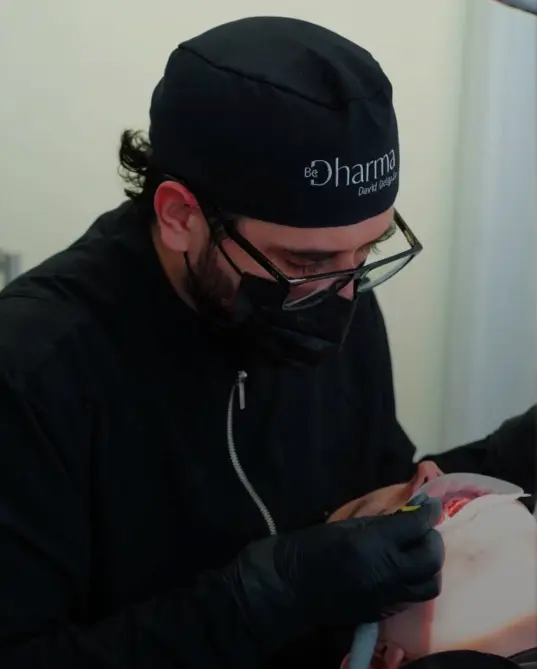
Your Dental Implant Journey Starts Before You Travel
Planning your treatment begins long before you arrive in Medellín. At Dharma Dental, we use the first stage to understand your needs, gather the right clinical information, and guide you toward the most appropriate type of evaluation. This allows us to make every conversation more useful and helps you prepare for the process with realistic expectations.
Complete the Form and Tell Us About Your Case
The first step is to complete our contact form and share a few essential details about your situation. We will ask for your country of residence, your main dental concern, any previous dental treatments, and the reason you are considering implant treatment.
You do not need to have every answer or diagnostic record at this stage. The purpose of the form is to give us enough context to understand where you are in the process and how we should guide you.
Helpful information to include:
- The tooth or area you would like us to evaluate
- Whether a tooth is missing, damaged, loose, or scheduled for extraction
- Previous implant, gum, or bone grafting treatments
- Relevant medical conditions or medications
- Your expected travel dates, when available
Sharing clear information from the beginning helps us identify what we may need before arranging your consultation.
Our Team Reviews Your Information Before Contacting You
Once we receive your form, our team reviews the information before reaching out. We do not treat this as a simple scheduling request. We look at the details you have provided to determine whether we need photographs, previous X-rays, a dental CT scan, or additional clinical information.
This initial review also helps us decide whether your first appointment should be virtual or in person. For patients who are still outside Colombia, we will usually explain which records are needed before the virtual consultation so the dentist can assess the case with meaningful diagnostic information.
Why do we review your case first?
Because a useful consultation requires more than a description of the problem. The right images and records allow us to discuss your situation with greater clinical accuracy.
We Help You Organize the Next Step
After reviewing your information, we will contact you with clear instructions. Depending on your location and the records already available, we may guide you through scheduling a virtual consultation, obtaining a dental CT scan, sending diagnostic files, or arranging an in-person evaluation in Medellín.
At this stage, we can help you understand:
- Which diagnostic records you need
- How to send them securely for review
- Whether your first consultation can be virtual
- What the next clinical step may involve
- What information you should consider before planning your trip
This guidance is not yet a final treatment plan. A definitive diagnosis can only be confirmed after we review the necessary imaging and complete an in-person clinical examination. Our role at this point is to help you move forward in an organized way, without assumptions or premature promises.
You may be interested Dental implants cost in Colombia: prices, factors and treatment planning
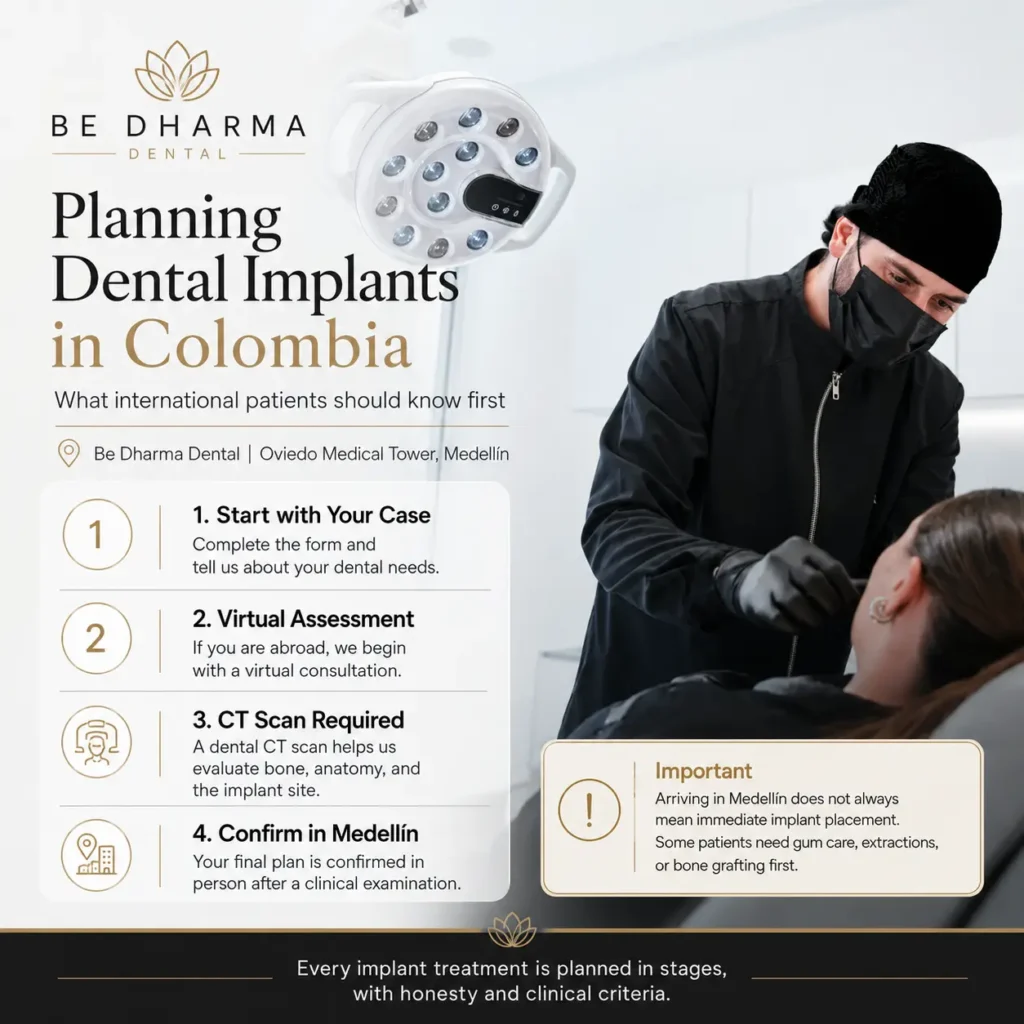
Professional treatment: why in-office care offers more control
You do not have to travel to Medellín just to begin the conversation. When you are still in your home country, we can arrange a virtual consultation to learn about your case, review your diagnostic records, and give you an initial understanding of the stages your treatment may involve.
For this appointment to be clinically useful, however, we need more than a description of the missing tooth or the symptoms you are experiencing. Implant planning requires diagnostic images that allow us to evaluate the area beneath the gums, especially the bone and nearby anatomical structures.
You Will Need a Dental CT scan Before the Appointment
Before your virtual consultation, we will ask you to obtain a dental CT scan, also known as a cone-beam computed tomography or CBCT scan. Unlike a regular photograph or a two-dimensional X-ray, this examination provides three-dimensional information about the jaws and the area where an implant may be placed.
The scan helps us evaluate important factors such as:
- The height, width, and shape of the available bone
- The location of nearby anatomical structures
- The condition of the proposed implant site
- Areas where bone loss may be present
- Whether additional evaluation or a preparatory procedure could be necessary
Professional implant-imaging guidance recognizes cross-sectional imaging as an important resource for assessing implant sites and their relationship to relevant anatomical structures.
Planning your trip before obtaining the scan can leave important questions unanswered.
Reviewing it first helps us have a more informed conversation about your case and identify issues that could affect your expected treatment sequence.
Send Your CT scan and Clinical Records in Advance
We ask you to send the requested records before the appointment, not while the consultation is already taking place. This gives our dental team time to organize the information and verify whether the files can be reviewed correctly.
Depending on your case, we may request:
- Your dental CT scan and its original digital files or viewing link, when available
- Recent panoramic or periapical X-rays
- Clear photographs of your teeth, gums, and smile
- Previous dental reports or treatment plans
- Information about extractions, implants, bone grafts, or gum treatments you have already received
- A list of relevant medical conditions and medications
A screenshot of one CT image may not contain all the information available in the complete study. For that reason, we will explain which format you should request from the diagnostic center in your country.
What We Can Determine During a Virtual Consultation
During the consultation, we review your main concern, dental history, images, and travel expectations. We can then discuss the findings visible in the records and outline a preliminary clinical route.
The appointment may help us identify whether your process could involve:
- An in-person examination and confirmation of the implant site
- Treatment of the gums, an infection, or another active oral condition
- Extraction of a tooth that cannot be preserved
- Bone grafting or another procedure to prepare the site
- Implant placement followed by a healing period
- A later restorative phase for the definitive tooth or prosthesis
This does not mean that every patient will need all these stages. It means we can begin identifying which ones may be relevant and explain how they could influence the number of visits, the treatment sequence, and your travel planning.
What the virtual consultation can—and cannot—do
| During the virtual consultation, we can: | We cannot confirm remotely: |
|---|---|
| Review the diagnostic records you send | The exact condition of your gums and soft tissues |
| Discuss the visible bone conditions | How the area responds to direct clinical examination |
| Identify possible preliminary treatments | The final surgical approach |
| Outline a preliminary sequence | A definitive treatment timeline |
| Answer questions about the process | That the implant can be placed immediately after arrival |
Why the Final Plan Must Be Confirmed in Person
A virtual appointment is the beginning of the assessment, not a substitute for examining you in the dental chair. Although the CT scan gives us valuable three-dimensional information, implant treatment must also consider findings that require direct evaluation, including the condition of the gums, oral hygiene, tooth mobility, available restorative space, bite, and surrounding teeth.
Once you arrive in Medellín, we compare the imaging with the clinical examination. We may confirm the preliminary route or adjust it if we find an infection, active gum disease, insufficient tissue, a tooth that requires treatment, or another condition that was not fully evident remotely.
Clinical guidance also emphasizes that imaging decisions and implant planning should be connected to the individual patient’s needs and a thorough clinical examination.
For this reason, when discussing dental implants in Colombia, we speak honestly about a preliminary plan after the virtual consultation and a definitive plan after the in-person assessment. This distinction protects your health, improves the quality of planning, and prevents us from making promises before we have all the clinical information.
Once You Arrive in Medellín, We Confirm Your Clinical Conditions
The virtual consultation helps us prepare, but the in-person appointment is where we confirm whether the proposed treatment is clinically appropriate. When you arrive in Medellín, we compare your diagnostic images with what we observe directly in your mouth before scheduling any surgical procedure.
Your In-Person Evaluation Comes Before Any Procedure
During your appointment, we do not look only at the space where a tooth is missing. We examine the complete clinical environment that could influence the implant and its future restoration.
Our evaluation may include:
- The condition of your gums and surrounding soft tissues
- The amount of space available for the future tooth
- The teeth next to and opposite the implant site
- Your bite and the forces placed on the area
- Signs of infection, inflammation, decay, or tooth mobility
- The shape and condition of the ridge where the implant may be positioned
- Your current oral hygiene and ability to maintain the future restoration
We also review your medical history, medications, previous dental procedures, and any changes that may have occurred since the virtual consultation.
Our first priority is not to place the implant as quickly as possible. It is to confirm that the site—and the rest of your mouth—can support the treatment safely and predictably.
You Can Have Your CT Scan at Oviedo Medical Tower
If you are already in Medellín and do not have a recent dental CT scan, we can guide you to one of our diagnostic partners located in the same Oviedo Medical Tower.
This makes it easier to complete the study and continue with your clinical evaluation without having to coordinate appointments in different parts of the city. Once the images are available, we review the implant site, the available bone, and its relationship with nearby anatomical structures.
A previous scan may still be useful, but we first need to check when it was taken, what area it covers, and whether the files provide the information required for your current treatment.
Your Preliminary Plan May Be Confirmed or Adjusted
When the clinical examination matches the findings we reviewed remotely, we may confirm the preliminary sequence discussed during your virtual appointment. However, we may also discover conditions that require us to adjust it.
For example, the in-person examination may reveal:
- Gum inflammation that was not visible in photographs
- A neighboring tooth that needs treatment
- An infection around a tooth or extraction site
- Less restorative space than initially expected
- Bite forces that could affect the implant restoration
- Soft-tissue or bone conditions that require additional preparation
This is why we describe the virtual proposal as a preliminary route rather than a final surgical plan.
Arriving in Medellín Does Not Mean Receiving the Implant Immediately
Traveling to Colombia does not automatically mean that your implant will be placed during your first visit. Before moving forward, we need to confirm that there is no active condition that could compromise the surgical site or affect the healing process.
There are cases in which implant placement can be scheduled soon after the in-person assessment. In others, we first need to treat the gums, remove an infected or non-restorable tooth, allow an extraction site to heal, perform bone augmentation, or complete another necessary procedure.
When planning dental implants in Colombia, we explain this distinction before you travel whenever the available records allow us to anticipate it. However, the final decision is always based on your in-person clinical findings.
Your Mouth May Need Treatment Before the Implant Is Placed
Needing treatment before implant placement does not mean that something has gone wrong with the plan. It means we have identified a condition that should be managed before introducing an implant into the area.
Our objective is to prepare a healthy and stable oral environment for both the implant and the restoration that will later be attached to it.
Healthy Gums and Tissues Are Part of the Preparation
Healthy gums matter because the implant will remain in direct contact with the surrounding bone and soft tissues. If we find active periodontal disease, persistent bleeding, deep periodontal pockets, significant plaque accumulation, calculus, inflammation, or infection, we may recommend periodontal treatment and reevaluation before implant placement.
The International Team for Implantology states that residual periodontal pockets are associated with a risk of peri-implant disease and implant loss. Its clinical recommendations indicate that active periodontal therapy should be completed before implant placement in patients with periodontal compromise.
Depending on your findings, this preparatory phase may involve:
- Professional dental cleaning
- Removal of calculus below the gumline
- Periodontal therapy
- Treatment of localized inflammation or infection
- Improvement of daily oral hygiene
- A follow-up examination to confirm tissue response
We do not move forward based only on the appearance of the gums. We evaluate clinical signs such as bleeding, pocket depth, plaque control, tissue stability, and the condition of the proposed implant site.
Some Teeth May Need Treatment or Extraction First
An implant is part of a broader oral rehabilitation plan. For that reason, we also evaluate the health of the teeth that will remain in your mouth.
Before implant placement, it may be necessary to:
- Treat active tooth decay
- Complete root canal treatment on a tooth that can be preserved
- Remove a tooth with a poor prognosis
- Manage infection around a tooth or its root
- Replace or repair a defective restoration
- Stabilize a neighboring tooth that could affect the implant area
- Allow an extraction site to heal before continuing
The exact sequence depends on whether the problem is located at the future implant site or elsewhere in the mouth. In some cases, an extraction and implant placement may be considered within the same surgical stage. In others, healing or additional preparation is required first.
Bone Grafting May Be Necessary Before Implant Placement
A dental implant needs enough bone around it to be positioned correctly and remain surrounded by supporting tissue. After tooth loss, trauma, infection, or previous extractions, the ridge may have lost width, height, or both.
When the available bone is insufficient, we may recommend a bone graft or another augmentation procedure. The purpose is not simply to add volume; it is to create the anatomical conditions needed to place the implant in a position that supports the future restoration.
Bone grafting may be performed:
- Before implant placement, followed by a healing period
- At the same appointment as implant placement
- As part of a more extensive reconstruction in complex cases
The sequence depends on the size and location of the defect, the ability to place the implant in the planned position, and whether adequate initial stability can be achieved.
The ITI’s 2023 consensus recommendations note that bone augmentation is indicated in situations such as buccal bone dehiscence or a thin facial bone wall, because leaving these deficiencies untreated may lead to less favorable clinical and radiographic outcomes.
A bone graft is not required for every implant patient.
We recommend it only when the clinical examination and diagnostic imaging show that the existing bone conditions are insufficient for the planned treatment.
We Only Move Forward When Your Oral Health Is Ready
Preliminary treatments are not unnecessary delays. They are part of the implant process when they help us control disease, prepare the surgical site, preserve neighboring structures, or improve the conditions for the final restoration.
Before scheduling implant placement, we confirm four essential points:
- Active infections have been treated or controlled.
- The gums and surrounding tissues are in an acceptable condition.
- There is enough bone, or a clear plan to reconstruct it.
- The implant can be positioned according to the restorative plan.
Some patients complete this preparation quickly. Others need more than one phase before the implant can be placed. From the first consultation, we explain what we have identified, why each step is necessary, and how it may affect your treatment and travel timeline.
Dental Implants in Colombia with Dharma Dental
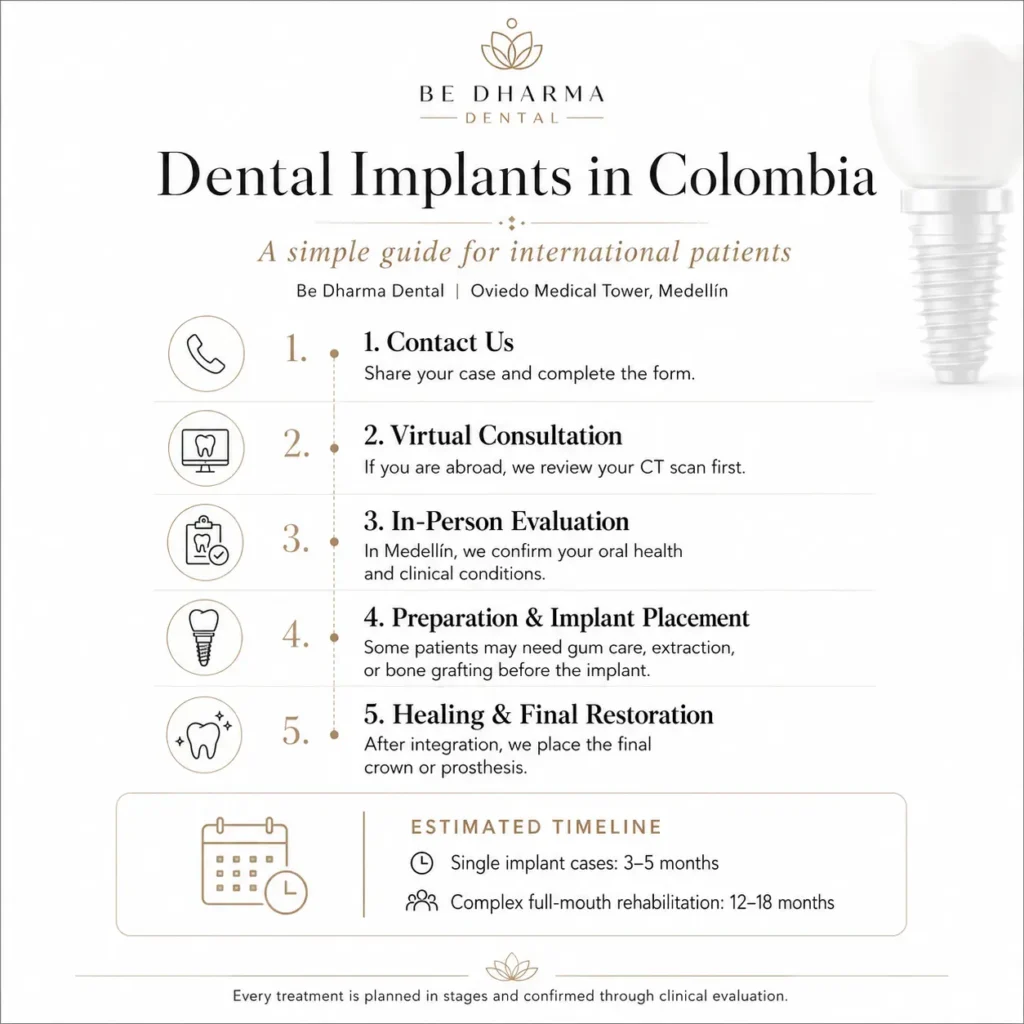
At Dharma Dental, located in Oviedo Medical Tower in Medellín, we guide every patient through a clear, staged process. We begin by reviewing your dental CT scan, completing an in-person examination, and defining a personalized treatment plan. If your mouth requires periodontal care, an extraction, bone grafting, or another preparatory procedure, we complete those steps first. Once the area is healthy and ready, we place the implant according to the clinical plan and allow time for healing and osseointegration before moving forward with the final restoration.
After we confirm that the implant has integrated properly, we design and place the crown, prosthesis, or full-mouth restoration indicated for your case. A straightforward case involving a single implant may take approximately 3 to 5 months, while complete rehabilitation involving bone grafts, several procedures, or full-mouth treatment may require 12 to 18 months. These timelines depend on your starting condition, the treatments you need, and how your body heals. From your first consultation, we explain the expected stages, estimated timing, and clinical reason for each step honestly, so you can plan your treatment and travel with greater confidence.
Frequently Asked Questions About Dental Implants in Colombia
1. Can I begin the process before traveling to Colombia?
Yes. If you are outside the country, we can begin with a virtual consultation. Before the appointment, we will ask you to send a recent dental CT scan and any additional records needed to review your case. This allows us to discuss a preliminary treatment route before you organize your trip.
2. Do I need a dental CT scan for the virtual consultation?
Yes. A dental CT scan provides three-dimensional information about the available bone, the proposed implant site, and nearby anatomical structures. Without this examination, we cannot assess the case with enough clinical information to provide meaningful preliminary guidance.
3. Can I use a CT scan taken in my home country?
In many cases, yes. We first need to confirm when the scan was taken, which areas it covers, and whether the complete digital files are available. A screenshot or printed image may not contain all the information we need, so our team will explain what you should request from the diagnostic center.
4. Is the treatment plan confirmed during the virtual consultation?
No. The virtual consultation helps us review your records, identify possible treatment needs, and outline a preliminary sequence. The final diagnosis and treatment plan are confirmed only after we examine your mouth, gums, bite, surrounding teeth, and implant site in person.
5. Can I receive the implant as soon as I arrive in Medellín?
Not necessarily. Arriving in Medellín does not automatically mean that the implant will be placed during your first appointment. We first need to confirm that your oral health, bone, gums, and surrounding structures are ready for the procedure. If we identify an infection, active gum disease, insufficient bone, or another condition, we may need to treat it first.
6. What treatments might I need before implant placement?
Depending on your diagnosis, you may need periodontal treatment, professional cleaning, treatment for tooth decay, root canal therapy, an extraction, bone grafting, or another preparatory procedure. These steps are recommended only when they are necessary to create healthier and more stable conditions for the implant and final restoration.
7. Can I have my dental CT scan in Medellín?
Yes. If you are already in Medellín and do not have a recent scan, we can guide you to one of our diagnostic partners located in the same Oviedo Medical Tower, where Dharma Dental is based. This makes it easier to complete the study and continue with your in-person evaluation.
8. How long does a single dental implant process take?
A straightforward case involving a single implant may take approximately 3 to 5 months. This usually includes implant placement, the healing and osseointegration period, and the final restoration. The exact timeline may change depending on the condition of the site, whether an extraction is needed, and how your body heals.
9. How long can complete oral rehabilitation take?
A complex rehabilitation involving multiple implants, bone grafting, several surgical stages, or full-mouth treatment may take approximately 12 to 18 months. Every case is different, so we explain the expected stages and timing after reviewing the diagnostic records and completing the clinical examination.
10. Will I need to travel to Medellín more than once?
Possibly. Implant treatment is completed in stages, and many international patients need more than one visit. The number and duration of your trips depend on whether you require preliminary treatments, bone grafting, healing time, implant placement, and a later appointment for the final restoration. When planning dental implants in Colombia, we explain the expected travel sequence from the first consultation as clearly and honestly as possible.
Última revisión médica: agosto de 2026