Universidad de Antioquia · Diplomado en Odontología Estética · Esp. Auditoría en Salud (CES)
Más de 17 años de experiencia en odontología clínica y estética
TP 70196663 · Registro profesional 5-4513-08
When a front tooth is fractured, worn down, weakened, deeply discolored, or already has a large restoration, it can affect much more than the way your smile looks. In the right case, dental crowns in front teeth allow us to rebuild the tooth, protect the remaining structure, and restore a more balanced appearance. The key is planning: a well-designed front tooth crown should blend into your smile so naturally that it does not immediately look like a dental restoration.
At Be Dharma Dental, we approach crowns for front teeth with particular attention to color, shape, translucency, proportion, and the way the tooth relates to the rest of your smile. Our goal is to create natural looking crowns for front teeth that restore both aesthetics and function without making the result look oversized or artificial. If you are considering cosmetic dental treatment in Medellín, Colombia, understanding when a crown is truly indicated is the first step toward choosing the right treatment for your smile.

When Is a Crown the Right Choice for a Front Tooth?
Not every damaged or discolored front tooth needs a crown. Before recommending one, we look at how much healthy tooth structure remains, how strong the tooth is, whether it has had previous treatment, and whether a more conservative option can achieve a predictable result.
A crown becomes especially useful when the tooth needs more than cosmetic improvement: it also needs protection, reinforcement, or reconstruction.
A broken, cracked or severely worn front tooth
A small chip can often be treated conservatively. But when a front tooth has lost a significant amount of structure, has a deep fracture, or has become severely worn, simply adding composite resin may not provide the strength or stability the tooth needs.
In these cases, we may recommend a crown because it covers and protects the remaining tooth while allowing us to rebuild its original shape, proportion, and function.
When a large filling has weakened the tooth
A tooth can sometimes look relatively intact from the outside while much of its internal structure has already been replaced by restorative material.
When only a limited amount of healthy enamel and dentin remains, the tooth may become more vulnerable to fracture. A crown can then help restore its shape while providing additional protection.
After a root canal on a front tooth
A root canal does not automatically mean that every front tooth needs a crown.
When evaluating a front tooth crown after root canal, one of the main factors we consider is the amount of remaining tooth structure. A minimally damaged tooth may need a different approach from one that is extensively fractured or previously restored.
When shape or discoloration cannot be corrected conservatively
Some front teeth have significant changes in color, shape, proportion, or structure that cannot be predictably corrected with whitening, bonding, or veneers alone.
A crown may then allow us to rebuild the visible portion of the tooth while controlling several aesthetic variables at the same time.
- Tooth shape and length
- Color
- Proportion
- Surface texture
- Symmetry with neighboring teeth
That decision should come from a clinical evaluation of the tooth’s remaining structure, function, bite, and aesthetic needs—not from appearance alone.
Ready to Find Out if a Front Tooth Crown Is Right for You?
At Be Dharma Dental, we do not begin with the restoration—we begin with your tooth. We evaluate its remaining structure, bite, color, position, neighboring teeth, and the way it fits within your smile before recommending treatment. If a front tooth crown is the right option, our goal is to restore strength and function while creating a result that looks natural, balanced, and consistent with your facial features.
What Can a Front Tooth Crown Change About Your Smile?
When we restore a front tooth, our goal is not to make it look “perfect.” We want it to look like it belongs in your smile. A well-planned crown can correct visible damage while respecting the proportions, color, texture, and character of the teeth around it.
That is why, when patients ask us what do front teeth crowns look like, the answer depends largely on how carefully the restoration has been designed. In a successful case, the crown should not be the first thing you notice.
Restoring a tooth that looks broken, short or uneven
A fractured or severely worn front tooth can disrupt the balance of the smile, especially when one tooth suddenly appears shorter or more irregular than the others.
With a crown, we can rebuild the missing structure and restore a more appropriate length and shape. The goal is not simply to make the tooth larger, but to recreate proportions that work with the neighboring teeth, gumline, and facial features.
Improving color without making the tooth look artificial
Front teeth are constantly exposed to light, which makes color selection especially important.
We evaluate the neighboring teeth, the color underneath the restoration, brightness, translucency, and how the crown behaves under different lighting conditions.
Creating better symmetry in the visible part of your smile
Symmetry does not mean making every tooth identical. We look for balance between tooth length, width, position, gingival contours, and the way the teeth relate to the lips and face.
When one front tooth has been damaged or heavily restored, correcting its shape can help restore visual balance across the smile.
Restoring strength without sacrificing aesthetics
A front tooth still plays an important functional role. It helps with biting, speech, and guiding certain jaw movements.
For us, aesthetic dentistry only makes sense when appearance and function work together. A crown should improve the way a compromised tooth looks while also providing the protection and structural support the case requires.
Shape, proportion, texture, function, and the relationship with the surrounding teeth all influence whether a front crown blends into the smile. So, do front teeth crowns look natural? They can. But natural-looking results depend on diagnosis, material selection, tooth preparation, laboratory work, and detailed planning behind the restoration.
What Are the Best Materials for Natural-Looking Front Teeth Crowns?
The material becomes particularly important when we are restoring a tooth in the front of the mouth. These teeth are visible when you smile, speak, and interact with others, so we need to consider much more than strength alone.
For natural looking crowns for front teeth, we evaluate how the material reproduces light, color, translucency, surface detail, and the characteristics of the neighboring teeth.
Ceramic crowns for front teeth: why aesthetics matter
Ceramic crowns for front teeth are frequently considered when aesthetics is a major priority because ceramic materials can reproduce many of the optical qualities we see in natural enamel.
Depending on the specific ceramic system used, we can work with different levels of translucency, brightness, and characterization to create a restoration that integrates more naturally with the surrounding teeth.
Patients may also encounter the term porcelain crowns for front teeth when researching treatment. Rather than choosing a material based only on its name, we focus on the clinical situation and the aesthetic characteristics we need to reproduce.
Zirconia crowns for front teeth: when can they be considered?
Zirconia crowns for front teeth may also be appropriate in selected cases. Modern zirconia materials are available in different formulations with varying levels of strength and translucency. This gives us options when a case requires greater resistance while still demanding an aesthetic result.
However, zirconia is not automatically the best choice for every anterior tooth. We consider factors such as the position of the tooth, the patient’s bite, the color of the underlying structure, the thickness available for the restoration, and how closely the crown needs to match adjacent natural teeth.
What makes a front tooth crown look natural?
The material matters, but it is only one part of the result. For a front crown to blend naturally, we pay attention to several details:
Shade matching
Not only how light or dark the tooth is, but also its undertones and variations.
Translucency
How light passes through the restoration, particularly around the incisal edge.
Shape
The crown should complement the patient's existing dental anatomy.
Surface texture
Natural teeth are not perfectly flat or uniformly smooth.
Proportions
Width and length need to make sense within the complete smile.
Gum integration
The transition between the crown and surrounding tissue should appear harmonious.
Neighboring teeth
The restoration must work as part of a group, not as an isolated object.
At Be Dharma Dental, this is the aesthetic standard we pursue: restorations that feel balanced, proportional, and individual to the patient rather than teeth that look overly white, uniform, or artificial.
Personalized dental assessment
Your front tooth crown should blend naturally into your smile
If you are considering a crown for a front tooth, the first step is determining whether it is truly the right treatment for you. At Be Dharma Dental, we evaluate your tooth structure, bite, neighboring teeth and aesthetic goals to plan a natural-looking result.
Front Tooth Crown or Veneer? Choosing the Right Treatment for Your Tooth
If you are comparing front teeth crowns vs veneers, the most important difference is not simply how they look. Both can produce highly aesthetic results, but they are designed for different clinical situations and require different amounts of tooth preparation.
When a veneer may preserve more of your natural teeth
When the tooth is structurally healthy and the concern is mainly related to color, shape, size, or another aesthetic characteristic, a veneer may allow us to improve its appearance while preserving more of the natural tooth.
That is why, when someone asks us about veneers or crowns for front teeth, we do not automatically recommend the more extensive restoration. We first determine whether the tooth actually needs full coverage.
When a full crown may offer better protection
The situation changes when a front tooth has lost a substantial amount of structure because of a large fracture, extensive previous restorations, severe wear, or other structural damage.
A veneer primarily covers the visible front surface of the tooth, whereas a crown provides much more extensive coverage. When the remaining tooth is compromised, that additional coverage may be necessary to rebuild its shape and provide the protection the case requires.
Lin et al., 2025
Why the decision should be based on your teeth, not only your desired look
When comparing a front tooth crown vs veneer, it can be tempting to choose based on before-and-after photographs alone. From our clinical perspective, that is the wrong place to start.
Before recommending either treatment, we assess:
- How much healthy enamel and dentin remain
- Whether the tooth has fractures or large restorations
- Its existing color and shape
- The condition of the bite
- Previous root canal treatment
- The position of the tooth within the smile
- How much tooth preparation each option would require
Two patients may want a very similar aesthetic result and still need completely different treatments.
At Be Dharma Dental, we prefer to begin with a simple question: what is the most conservative treatment that can predictably restore this tooth?
Sometimes the answer is a veneer. When the tooth needs greater structural protection, it may be a crown. The final appearance matters, but preserving health, function, and natural tooth structure should be part of that decision from the beginning.
Getting Front Teeth Crowns in Medellín: Why Choose Be Dharma Dental?
At Be Dharma Dental, every front tooth crown is planned to look natural, balanced, and consistent with the rest of your smile. We evaluate the condition of the tooth, your bite, neighboring teeth, color, proportions, and facial harmony before recommending treatment. We welcome local and international patients at our clinic in Torre Médica Oviedo, Medellín, with a personalized approach focused on function, aesthetics, and natural-looking results.
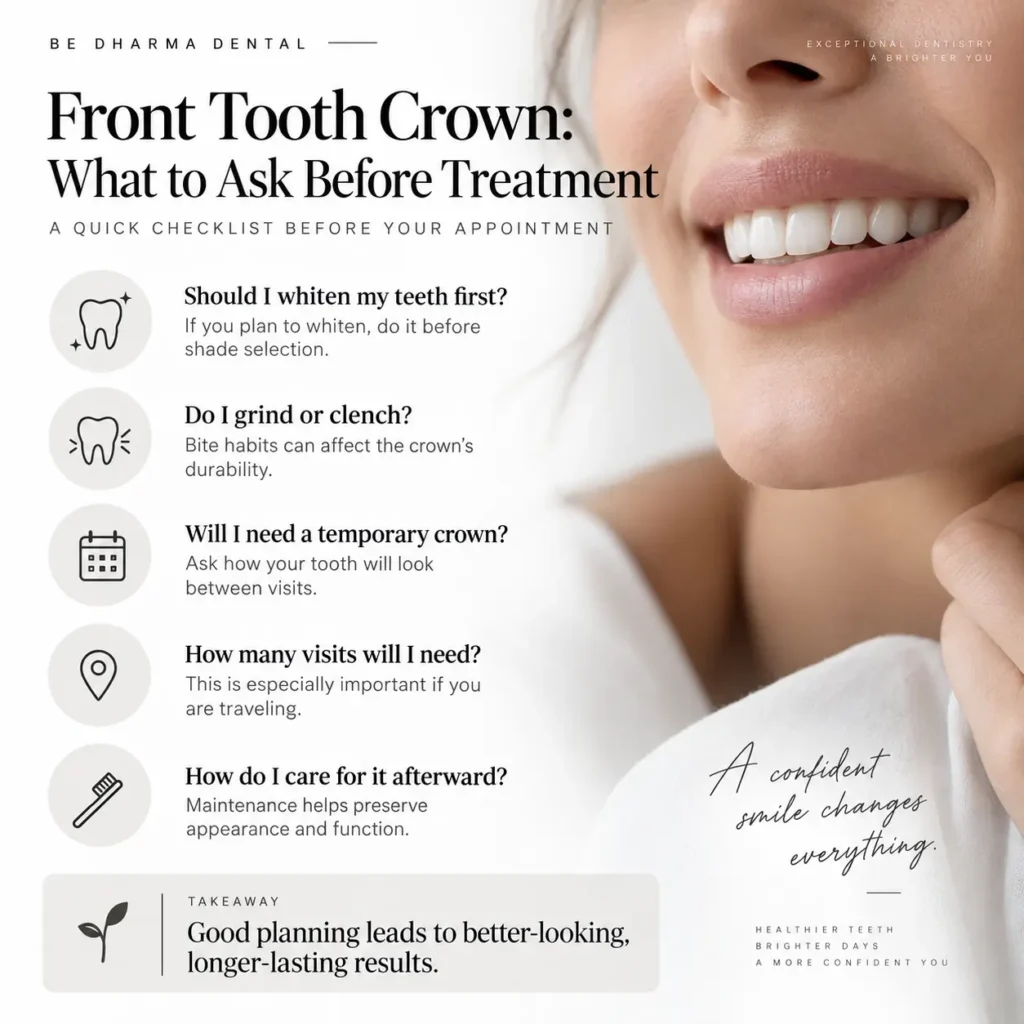
If you are looking for dental crowns in Medellín, Colombia or considering dental tourism in Colombia, we can help you understand your case, the expected number of appointments, and whether a crown is truly the right option for your tooth.
Frequently Asked Questions About Dental Crowns in Front Teeth
Do front teeth crowns look natural?
Yes. Well-planned dental crowns in front teeth can look very natural when the material, shade, translucency, shape, and surface texture are carefully matched to the surrounding teeth. The goal is for the crown to blend into the smile rather than stand out as a restoration.
What is the best material for a front tooth crown?
There is no single material that is best for every patient. Ceramic and zirconia-based restorations can both be appropriate depending on the condition of the tooth, its underlying color, the bite, the position of the tooth, and the aesthetic result we need to achieve. The best material for front teeth crowns should always be selected after a clinical evaluation.
How long do front teeth crowns last?
A front tooth crown can last for many years, but its longevity depends on several factors, including oral hygiene, bite forces, grinding or clenching, the amount of natural tooth structure remaining, and regular dental checkups. Good maintenance is essential to protect both the crown and the tooth underneath.
Is getting a crown on a front tooth painful?
The procedure is usually performed under local anesthesia, so patients should not feel pain while the tooth is being prepared. Some temporary sensitivity may occur afterward, especially around the gum or prepared tooth, but this usually improves as the area settles.
Can a crown fix a chipped or broken front tooth?
Yes, a crown can be a good option when a front tooth has lost a significant amount of structure. However, smaller chips may be treated more conservatively with bonding or another restoration. We recommend a crown when the remaining tooth needs greater protection or structural support.
Is a crown better than a veneer for a front tooth?
Not necessarily. When comparing a front tooth crown vs veneer, the right choice depends on the condition of the tooth. A veneer may be suitable for a structurally healthy tooth that mainly needs an aesthetic improvement, while a crown may be more appropriate when the tooth is heavily restored, fractured, weakened, or extensively damaged.
Can I get a crown after a root canal on a front tooth?
Yes, but a front tooth crown after root canal treatment is not automatically required in every case. We evaluate how much healthy tooth structure remains, whether the tooth has previous restorations or fractures, its bite, and its aesthetic condition before deciding on the most appropriate restoration.
How much does a front tooth crown cost?
The price varies depending on the material, the number of teeth being treated, the condition of the natural tooth, and whether additional procedures are required. For that reason, the most accurate way to determine the cost is through a personalized assessment rather than relying on a standard price.
Can a front tooth crown be matched to my natural teeth?
Yes. Shade matching is a fundamental part of treating front teeth. We evaluate color, brightness, translucency, texture, and the characteristics of neighboring teeth so the restoration integrates as naturally as possible. This is especially important when only one front tooth is being restored.
Can international patients get front teeth crowns in Medellín?
Yes. Patients considering dental crowns in Medellín, Colombia can plan their treatment before traveling so they have a clearer idea of the required appointments, expected treatment time, and follow-up needs. At Be Dharma Dental, we welcome international patients and provide personalized planning at our clinic in Torre Médica Oviedo, Medellín.
References
- Edelhoff, D., & Sorensen, J. A. (2002). Tooth structure removal associated with various preparation designs for anterior teeth. The Journal of Prosthetic Dentistry
- Lin, J., Bennani, V., Aarts, J. M., Brunton, P., & Ratnayake, J. (2025). Factors influencing success rate of ceramic veneers on endodontically treated anterior teeth: A systematic review. The Journal of Prosthetic Dentistry
The information provided in this article is for educational and medical information purposes only and does not replace an individual dental evaluation. Every patient, tooth, and clinical situation is different. A personalized assessment with a qualified dental professional is essential to determine whether a front tooth crown, veneer, or another treatment is the most appropriate option for your case.
Última revisión médica: septiembre de 2026